Portugal is a small country that contains multitudes. You can drive from the Atlantic dunes of Comporta to the schist terraces of the Douro Valley in three hours, and the two places share almost nothing — not the landscape, not the pace, not the kind of traveller who finds each one right. The question of where to stay in Portugal is not answered by a list. It is answered by a different question: what kind of traveller are you?
After twenty years working in Portuguese tourism, the observation that has held up consistently is this: the visitors who leave disappointed almost always chose a destination based on name recognition rather than fit. They went to the Algarve because everyone goes to the Algarve, when what they actually wanted was the silence of the Alentejo coast. Or they came to Lisbon for a week when three days would have been perfect and four more days in Sintra or the Douro would have been extraordinary.
This guide is an attempt to solve that problem — not by ranking destinations, but by being honest about what each one is actually like, who it is for, and who it is probably not for. Read it as you would advice from someone who knows the country well and has no reason to oversell any particular corner of it.
The Algarve — The Reliable Classic
The Algarve is Portugal's most visited region for good reason. The coastline between Sagres and Tavira contains some of the most dramatic and varied beach scenery in Europe — limestone cliffs, sea caves, long Atlantic stretches, sheltered east-facing coves. The infrastructure is excellent, the weather reliable from April to October, and the range of accommodation from family villas to design hotels is wider here than anywhere else in the country.
What the Algarve is not is a secret. If you are coming to Portugal specifically to escape crowds and find an undiscovered corner, the western Algarve in August is not your destination. But if you want a reliably beautiful place to spend a week in the sun, with good restaurants, excellent beaches, and accommodation that delivers what it promises, the Algarve rarely disappoints.
The region divides clearly into three characters. The western Algarve — around Lagos, Sagres, and the Costa Vicentina — is wilder, more windswept, and more sparsely developed. The central Algarve — Albufeira, Vilamoura, Quinta do Lago — is the most developed stretch, with golf resorts, marina living, and family infrastructure. The eastern Algarve — Tavira, Castro Marim, the Ria Formosa — is the most authentic and least touristed, with a completely different atmosphere from the rest.
You want guaranteed sun, great beaches, excellent infrastructure, and a wide choice of accommodation. First-time visitors to Portugal. Families with children. Those who prioritise beach access and water activities.
Read: Tavira guide → Explore Algarve stays →Comporta & the Costa Alentejana — Quiet Luxury
Comporta is the most discussed and least understood destination in Portugal at the moment. It has attracted significant international attention — from fashion magazines, from wealthy second-home buyers, from the kind of traveller who instinctively moves toward places before the mainstream arrives — and with that attention has come some inflation of both prices and expectations.
What Comporta actually is, stripped of the mythology, is this: a small village surrounded by rice fields and cork oak forests, backed by some of the longest and least developed Atlantic beaches in southern Portugal, with a handful of genuinely good restaurants and an atmosphere that rewards people who can find pleasure in simplicity. There are no nightclubs, no high-rises, no tourist infrastructure in the conventional sense. The beach bars serve good wine and grilled fish and close when the sun goes down.
The Costa Alentejana that stretches north from Comporta — through Melides, Porto Covo, Vila Nova de Milfontes — shares the same essential character: wild Atlantic coast, minimal development, and a pace that is genuinely unhurried rather than performatively slow.
"Comporta rewards the traveller who can find genuine pleasure in simplicity — and quietly disappoints the one who mistakes silence for lack of sophistication."
José Graça · PrimeStaysYou want wild beaches, minimal crowds, and genuine quiet. Couples and small groups. Design-conscious travellers. Those who have already done the Algarve and want something with less infrastructure and more atmosphere. June or September — not August.
Explore Comporta & Costa Alentejana →Lisbon, Sintra & Cascais — The Urban Anchor
Lisbon is one of the most beautiful capital cities in Europe and one of the most frequently over-visited by people who would have been happier spending two fewer days there and two more days somewhere else. That is not a criticism of Lisbon — it is an observation about how most visitors use it. Three days in Lisbon is an excellent trip. Seven days in Lisbon, for most people, is three days in Lisbon and four days being vaguely disappointed that it started to feel repetitive.
The city works best as an anchor combined with day trips or short extensions. Sintra — forty minutes by train — is genuinely one of the most extraordinary places in the country: UNESCO-listed, forested hills studded with palaces, and an atmosphere unlike anything else in Portugal. Cascais is the most pleasant base for those who want ocean proximity without committing to the Algarve. Setúbal and the Arrábida coast south of Lisbon is arguably the most beautiful coastal landscape within easy reach of any major European capital.
You want city culture, food, architecture, and easy access to the coast and countryside. First-time Portugal visitors. Short breaks of 3–5 days. Those combining Portugal with other European destinations. Travellers who want the widest range of restaurants and cultural experiences.
Explore Lisboa region stays →Silver Coast — The Underrated Atlantic
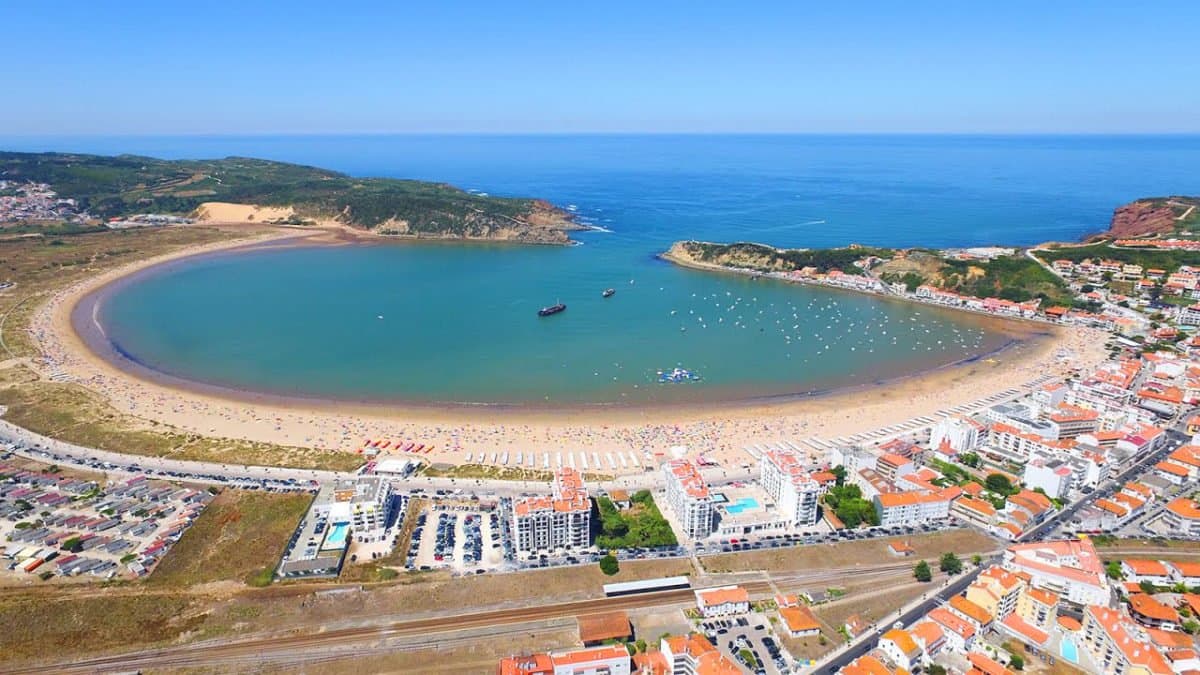
The Silver Coast — the stretch of Atlantic coastline between Lisbon and Porto, centred on Óbidos, Nazaré, and Peniche — is consistently underestimated by international visitors who fly over it on the way to one end of the country or the other. This is a mistake, and increasingly the travellers who figure this out are the ones who come back.
The Silver Coast has everything: medieval walled towns, serious surf, some of the largest Atlantic waves in the world at Nazaré, excellent wine from the Bairrada and Dão regions just inland, and a cooler, greener climate than the south that makes it more pleasant in summer and surprisingly mild in winter. Óbidos, enclosed within its medieval walls, is one of the most photogenic towns in the country. The beaches are long, usually uncrowded, and backed by pine forests rather than development.
You want Atlantic coast without Algarve prices or crowds. Surfers. Those combining beach with culture and countryside. Wine enthusiasts. Visitors making a Porto-to-Lisbon road trip. Year-round destination — mild even in winter.
Explore Silver Coast stays →The Douro Valley — Wine Country at its Most Cinematic
The Douro Valley is the destination most likely to produce the reaction: "I had no idea Portugal had this." The terraced vineyards cut into schist slopes above a wide, slow river, the quintas with their centuries-old cellars, the silence and the specific quality of light in September — it produces a landscape that has no real equivalent in Portugal and few equivalents in Europe.
It is also genuinely a wine destination in the full sense — not a place with a winery you can visit on a tour, but a place where the entire landscape is a working wine estate, where the quinta you are staying in produces the bottle on your dinner table, and where the people who pour the wine made it. For wine enthusiasts, it is among the most rewarding destinations in the world. For travellers who are not particularly interested in wine, it is still extraordinarily beautiful — but the depth of the experience depends on engagement with what the landscape is actually producing.
The Douro Valley is best visited in September or October during the vindima — the harvest — or in May and June when the vines are green and the river is high. July and August are hot enough to be demanding.
You are a wine enthusiast or genuinely curious about wine culture. You want dramatic landscape and slow travel. You are happy in a quinta rather than a city hotel. Couples, small groups, solo travellers. September–October for harvest; May–June for green vines.
Explore Douro Valley stays →Porto — The City That Earns Its Reputation
Porto is one of those rare places where the reputation is deserved. It is a genuinely beautiful city — hilly, layered, azulejo-tiled, with a river frontage that is among the most photographed in Europe for good reason — and it has the kind of human scale that makes it easy to navigate and endlessly rewarding to explore on foot. The food is serious, the wine culture is serious, and the city operates with a directness and lack of pretension that makes it more enjoyable than cities that work harder at being charming.
Three days is the minimum to do it justice. Five days, combined with a day or two in the Douro Valley, is the ideal Norte de Portugal week. Porto is also the natural starting point for the Caminho de Santiago for travellers doing the Coastal route north.
You want an authentic Portuguese city experience without Lisbon crowds. Food and wine enthusiasts. Architecture lovers. Those combining city with Douro Valley. Year-round destination — the city works in winter as well as summer.
Explore Porto stays →Madeira — The Atlantic Garden
Madeira is a different country from mainland Portugal in every way that matters experientially. It is subtropical, volcanic, mountainous, and green in a way that no part of the mainland is. The levadas — the ancient irrigation channels that thread through the island's hillsides — provide some of the most rewarding walking in Europe, combining extraordinary scenery with routes that are genuinely accessible to non-expert walkers. The capital, Funchal, is a proper city with good restaurants, a serious wine culture built around Madeira wine, and the kind of comfortable infrastructure that makes it usable as a base for the whole island.
Madeira works as a year-round destination in a way that few island destinations do. The climate is temperate rather than hot — warm enough to be pleasant in winter, rarely brutal in summer. It attracts a mix of serious walkers, garden enthusiasts, families looking for an active holiday, and winter-sun seekers who want something more interesting than a beach resort.
You want subtropical landscape, walking, and a genuinely different experience from mainland Portugal. Nature lovers. Active travellers. Winter-sun seekers who want more than a beach. Those who want to combine city comfort with extraordinary countryside. Year-round.
Explore Madeira stays →How to Choose — The Honest Framework
After twenty years advising on Portugal travel, the framework that consistently produces good outcomes is simple: match the destination to the pace, not the season or the Instagram feed.
For travellers deciding between Portugal and another Mediterranean destination — particularly Portugal versus Greece — the framework is the same: match the destination to the type of experience you are actually looking for, not the one you think you should want.
The travellers who leave Portugal most satisfied are almost always those who have committed to one region properly rather than tried to see everything in a week. A week in the Douro Valley, staying at a quinta, with two days in Porto at either end, is a more rewarding experience than trying to cover Lisbon, the Algarve, and Porto in seven days. Portugal rewards depth.
every fortnight.
Editorial picks, honest notes, new destinations before they go mainstream. Free, always.
Join the list