The Algarve has two coasts. There is the one you know — the western corridor of cliff-top resorts, golf developments, and airport transfers that runs from Faro to Lagos and receives several million visitors a year. And then there is the eastern Algarve: quieter, older, architecturally richer, and almost entirely overlooked by the international travel market. Tavira is its capital. And it is one of the most underestimated towns on the entire Iberian Peninsula.
The distinction between east and west Algarve has a name. Barlavento — the windward coast — runs west of Faro, catching the Atlantic swell that carved those famous sea-stack cliffs. Sotavento — the leeward coast — runs east toward Spain, sheltered and flatter, its beaches separated from the mainland by the lagoon system of the Ria Formosa. The same sun. Completely different character.
What happened to the Algarve in the second half of the twentieth century happened almost entirely to the Barlavento. Albufeira became a package holiday destination. Vilamoura built a marina. Portimão filled in its waterfront. The infrastructure that mass tourism requires — motorway access, airport proximity, flat land for hotel development — was all in the west. The Sotavento, without these advantages, was left largely alone. That is its greatest asset.
Why Tavira Stayed Tavira
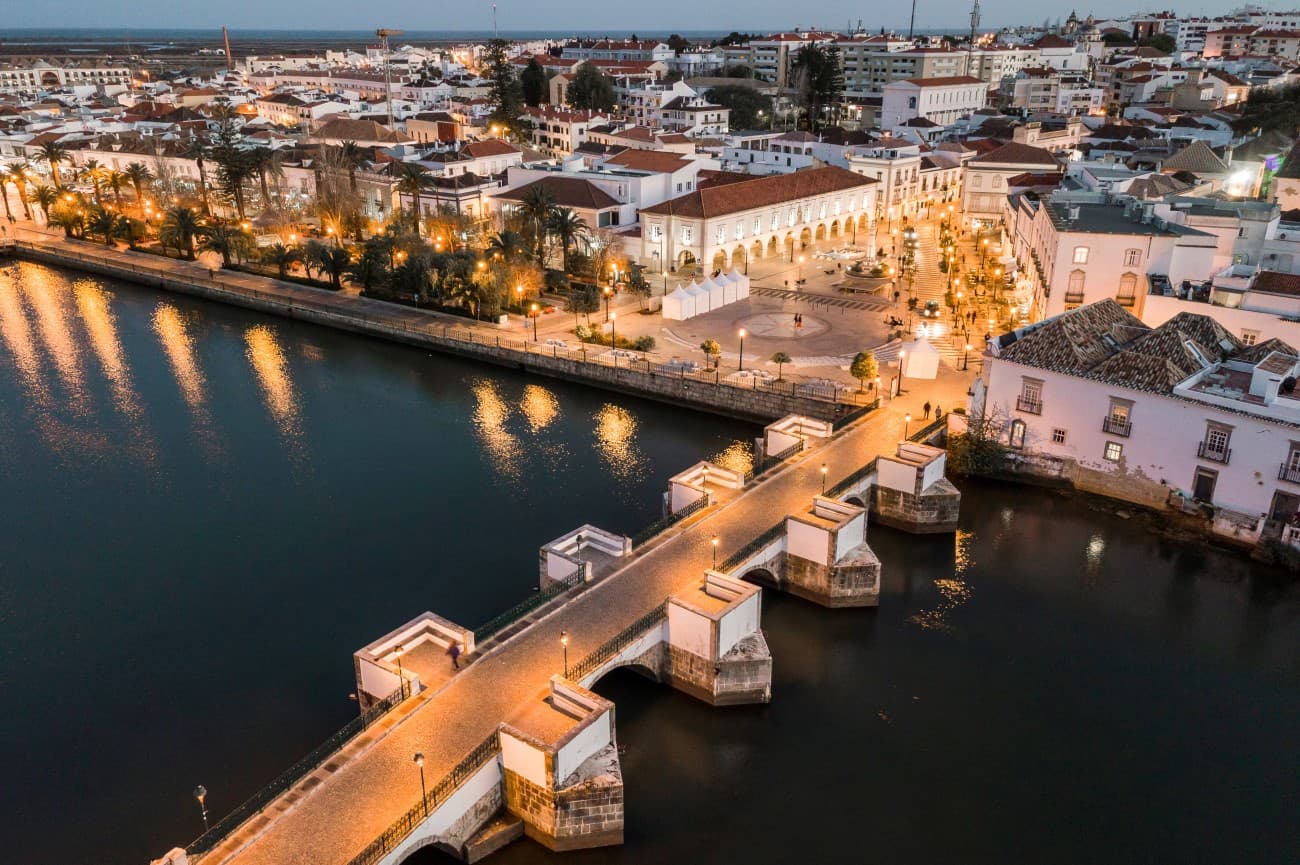
Tavira is, by any reasonable measure, the most architecturally beautiful town in the Algarve. This is not a contested claim — it is a straightforward observation that becomes obvious within about twenty minutes of arriving. The Roman bridge across the Gilão river. The ruins of the Moorish castle above the town. The forty-odd churches, several of them with ornate baroque interiors. The distinctive scissor-tiled rooftops — hip roofs with four sloping sides rather than the two-sided gables of most Portuguese architecture — that give Tavira its unmistakable silhouette.
The town survived the 1755 Lisbon earthquake better than most Algarve settlements, which is why so much of the pre-modern fabric remains intact. It survived the tourism boom of the 1970s and 1980s because the beach — Ilha de Tavira — is an island, reachable only by ferry from the town quay. That ferry crossing, trivial in practice, was enough to redirect the resort developers elsewhere. The inconvenience of a five-minute boat ride saved an entire town's character.
"A five-minute ferry crossing saved Tavira's entire character. The inconvenience that redirected developers is the same inconvenience that now makes the beach feel like a discovery."
PrimeStays EditorialToday, the ferry to Ilha de Tavira runs all summer from the quayside below the old town. The island beach is long, backed by dunes and maritime pine, and entirely free of the beach clubs and parasol concessions that define the western Algarve resort beaches. The water is warm — the Sotavento coast faces southeast rather than south or southwest, trapping warmer water in the Ria Formosa lagoon system. In September, when the Atlantic sea temperature at Sagres is dropping toward 18°C, the water off Tavira is still 22°C or above.
The Case Against the Western Algarve
This requires some honesty. The western Algarve — Quinta do Lago, Vale do Lobo, Vilamoura — is extremely good at what it does. The golf courses are among the best in Europe. The villa rentals are immaculate. The service infrastructure is mature and reliable. If you want a managed luxury experience with no friction and no surprises, the Barlavento delivers it consistently.
The question is what you're trading for that consistency. The western Algarve beach towns have, in varying degrees, lost the texture of actual Portuguese life. The restaurants that survive near the resort zones serve international menus at resort prices. The towns themselves — Albufeira in particular — have become entertainment districts that happen to be located in Portugal rather than places that feel genuinely Portuguese.
Tavira and the Sotavento offer the inverse trade. The infrastructure is less polished. There is no Michelin-starred restaurant, no golf course with a signature hole, no beach club with a DJ roster. What there is instead is a town where people actually live, where the fish comes off boats that you can see tied up at the quay, and where the price of a meal reflects what local people are willing to pay rather than what northern European visitors can be charged.
What the Lagoon Changes
The Ria Formosa Natural Park is the defining geographical feature of the eastern Algarve, and it is profoundly underappreciated outside Portugal. It is a coastal lagoon system — a series of barrier islands, tidal channels, salt marshes, and sandbanks that stretches for 60 kilometres from Faro to Cacela Velha near the Spanish border. It is one of the most important wetland ecosystems in Western Europe. It is also, incidentally, one of the most beautiful landscapes in Portugal.
The practical effect of the Ria Formosa on the eastern Algarve beach experience is this: the beaches are islands. Ilha de Tavira, Ilha da Armona, Ilha da Culatra — each requires a short ferry crossing from the mainland towns. These crossings take five to fifteen minutes. They are inexpensive and run frequently in summer. But they create a selection effect: only people who actually want to be at the beach make the trip. There are no cars. There is no passing trade. The beaches feel earned in a way that drive-to resort beaches never do.
The lagoon itself offers a second kind of experience entirely. Kayaking through the tidal channels at dawn, when the flamingos are feeding and the light is flat and copper-coloured, is one of the better things you can do in southern Portugal. The shellfish — clams, oysters, and cuttlefish — come directly from the lagoon and are eaten at restaurants on the waterfront within hours of leaving the water. The quality is exceptional. The prices are not.
Cacela Velha, Estói, and the Interior
Tavira is the anchor of the eastern Algarve, but the region has depth beyond the town. Cacela Velha is a fortified hilltop village fifteen kilometres east of Tavira — a handful of whitewashed houses, a small church, and a fort perched above a sweep of the Ria Formosa with views to the barrier islands beyond. It appears on almost no tourist itinerary. It has no hotels, no restaurants beyond a single seasonal café, and no reason to exist as a tourist destination except that it is extraordinarily beautiful and feels entirely untouched. It is worth the detour.
Estói, ten kilometres north of Faro in the Algarve interior, offers a different kind of reward. The village is known for two things: the neoclassical Palácio de Estói — a nineteenth-century palace with elaborate gardens and azulejo-tiled terraces that has been converted into a pousada — and the Roman ruins of Milreu immediately below the village, where a villa complex dating to the first century AD sits in open countryside with minimal fencing and almost no visitors. The combination of Roman archaeology, baroque palace gardens, and the general quietness of the Algarve interior makes Estói one of the most culturally rewarding day trips in the south of Portugal.
The interior of the eastern Algarve — the Serra do Caldeirão to the north — is almost entirely unvisited by international tourists. Cork oak forests, schist villages, and a landscape that feels entirely removed from the coastal Algarve experience. The villages of the Serra are economically marginal but architecturally intact, and several have been the subject of careful rural tourism development projects that offer a genuine alternative to the coastal villa model.
Why Now Is the Time
The eastern Algarve is not undiscovered. Portuguese families have been going to Tavira for summer holidays for generations. British expatriates have been buying property there since the 1990s. What it lacks is international profile — the kind of coverage in travel media that translates into search traffic, villa rental demand, and the gradual price inflation that follows attention.
That is beginning to change. Tavira appeared on multiple "best destinations" lists in 2023 and 2024, and the rental market has responded — not with the dramatic price increases of the Comporta or Quinta do Lago markets, but with a noticeable increase in quality inventory as owners invest in renovation. The window of getting the eastern Algarve before it achieves mainstream luxury status is still open. It will not stay open indefinitely.
The practical argument for the eastern Algarve is simple: you get a significantly more interesting cultural and landscape experience than the western resort corridor, at meaningfully lower prices, with fewer crowds at every point in the season. The ferry to the beach takes five minutes. The clams at the waterfront restaurant were in the lagoon this morning. The Roman bridge has been there for two thousand years and shows no signs of becoming less impressive.
The Algarve that travel brochures sell is a product. The eastern Algarve is a place. That distinction, increasingly, is worth a great deal.
every fortnight.
Editorial picks, honest notes, new destinations before they go mainstream.
Join the list