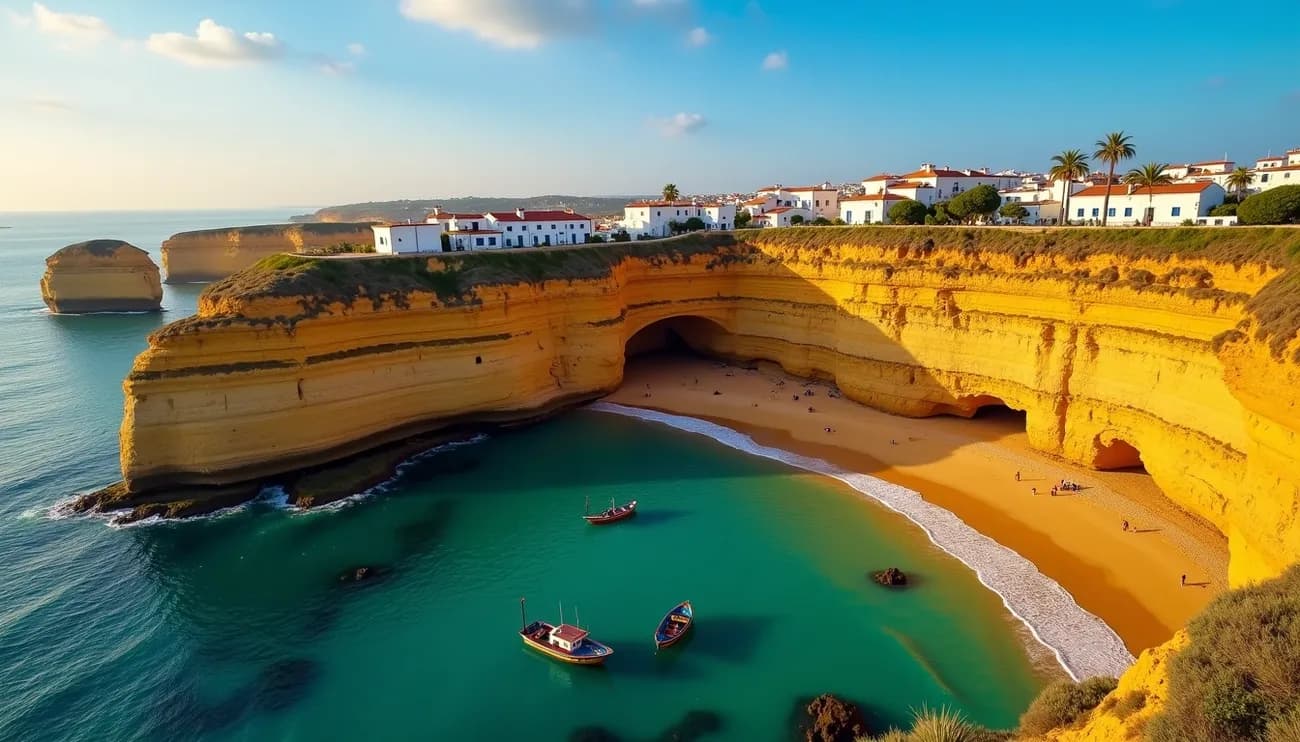
The Algarve is not a destination. It is a region — 150 kilometres of southern Portuguese coastline that contains at least three entirely distinct landscapes, half a dozen different characters, and accommodation ranging from private villas on clifftop promontories to golf resorts that could be in any country in the world. The persistent myth that the Algarve is a single place — warm, crowded, and best avoided — is the reason good visitors choose the wrong part of it and leave disappointed. The Algarve rewards those who choose correctly.
The fundamental division is geographical. The western Algarve — from Sagres to Lagos — faces the open Atlantic with dramatic limestone cliffs, sea caves, and beaches that are genuinely wild. The central Algarve — from Portimão to Faro — is the most developed stretch, with golf resorts, marina developments, and the infrastructure of a mature beach tourism industry. The eastern Algarve — from Faro to Vila Real de Santo António, across the Ria Formosa — is the most preserved, most authentic, and most consistently underestimated part of the coast.
This guide treats each part of the Algarve as the distinct destination it actually is — with honest assessments of who each suits best and when.
Western Algarve — Wild, Dramatic, Uncrowded
The western Algarve begins where the Portuguese mainland ends — at Sagres and Cabo de São Vicente, the southwesternmost point of continental Europe, where the Atlantic batters limestone cliffs that drop vertically to the sea. This is a different country from the central Algarve. The light is sharper, the wind is stronger, the beaches are longer and emptier, and the landscape has the particular quality of places that have resisted easy development: too exposed, too remote, too committed to being exactly what they are.
The town of Lagos is the western Algarve's anchor — a proper Portuguese town with a historic centre, good restaurants, and easy access to some of the most photographed rock formations in Europe. The beaches between Lagos and Sagres — Meia Praia, Luz, Burgau, Salema — are significantly quieter than anything in the central Algarve, with the kind of space in August that you cannot find further east. The Costa Vicentina to the north of Sagres is protected by the Parque Natural do Sudoeste Alentejano e Costa Vicentina and represents the wildest, most preserved Atlantic coastline remaining in southern Europe.
The most scenically dramatic part of the Algarve. Lagos is the best-serviced base. Sagres for serious surf and total remoteness. Costa Vicentina for wild Atlantic beaches without development. Less infrastructure than the central Algarve but more atmosphere and space.
Central Algarve — The Classic, Done Well or Done Badly
The central Algarve — the stretch from Portimão through Albufeira to Vilamoura and Quinta do Lago — is the part that built the region's reputation and, depending on how you use it, either confirms or destroys it. Done well, it is among the most comfortable and well-serviced beach destinations in Europe, with luxury villas, world-class golf courses, exceptional restaurants, and beaches that remain beautiful regardless of how developed the hinterland has become. Done badly — arriving in Albufeira in August without a careful choice of accommodation — it is everything the critics say it is.
Vilamoura is the central Algarve's most coherent resort — a private development built around a marina with consistent architecture, excellent golf, and a clientele that skews British, wealthy, and reliably well-behaved. Quinta do Lago and Vale do Lobo, just east of Faro, are the region's genuine luxury addresses — private estates where the quality of accommodation, the golf courses, and the service have been consistent for decades. These are not cheap, but they deliver what they promise: a level of discretion and quality that the Algarve's more popular destinations cannot match.
The Benagil Cave — the sea cave accessible by boat or by swimming from Benagil beach — is one of the most remarkable natural formations on the Atlantic coast of Europe. It has become significantly overcrowded in summer and is now best accessed at dawn or by booking a kayak tour from Carvoeiro that departs early enough to beat the main flow of day boats. The experience, when conditions are right, remains genuinely extraordinary.
"The central Algarve, done well, is among the most comfortable beach destinations in Europe. Done badly — the wrong area, the wrong month — it confirms every criticism."
José Graça · PrimeStaysThe Algarve's luxury heartland. Vilamoura for marina living and consistent quality. Quinta do Lago and Vale do Lobo for genuine premium — private estates with the best golf, beaches, and service in the region. Albufeira for those who want maximum choice and accept the trade-offs.
Eastern Algarve — The One Most Visitors Miss
The eastern Algarve — east of Faro, across the Ria Formosa lagoon system, as far as the Spanish border — is the part of the region that consistently surprises visitors who arrive without expectation. It is flatter, quieter, and built around a landscape that is entirely different from the limestone cliffs and open Atlantic of the west: a coastal lagoon of extraordinary ecological richness, with barrier islands accessible only by ferry, long stretches of sand that receive a fraction of the visitors of the western beaches, and towns that have maintained their Portuguese character with unusual integrity.
Tavira is the eastern Algarve's most distinguished town — elegant, unhurried, built along the banks of the Gilão river with a historic centre that rewards walking and a connection to the barrier islands via ferry that gives access to some of the best beaches in Portugal. We wrote about Tavira in more detail in an earlier Journal piece — it remains the part of the Algarve that most consistently exceeds expectations.
Cabanas de Tavira, Cacela Velha — a tiny fortified village on a promontory above the Ria Formosa — and the barrier island beaches of Ilha de Tavira and Ilha de Cabanas are the eastern Algarve at its best: genuinely quiet, genuinely beautiful, and genuinely Portuguese in a way that the central Algarve has not been for many years.
The Algarve's best-kept secret. Tavira is the region's most elegant town. The barrier islands — Ilha de Tavira, Ilha de Cabanas — have beaches with almost no development. The Ria Formosa is one of the most important wetland ecosystems in Europe. Go before everyone discovers it.
When to Go — The Honest Answer
The Algarve's season runs broadly from April to October, with July and August representing peak demand and the highest prices. The honest answer about timing depends entirely on which part of the Algarve you are visiting and what you want from it.
May and June are the best months for the western Algarve — warm enough for swimming, empty enough for the beaches to feel generous, and priced significantly below peak. The wildflowers on the Costa Vicentina in April and May are extraordinary.
July and August are unavoidable for families with school-age children, and the central Algarve handles this volume better than anywhere else in Portugal precisely because it has been built for it. Choose a well-selected villa in Quinta do Lago or Vilamoura and the summer peak is manageable. Choose Albufeira town centre and it is not.
September and October are the best months overall — the sea is at its warmest (having absorbed all summer), the crowds have thinned significantly, the prices have dropped, and the light in October over the eastern Algarve is as good as anywhere in Europe.
Which Algarve Is Right for You
The question is not whether to go to the Algarve — it is which Algarve to go to. They are genuinely different experiences, and the one you choose should reflect what you actually want rather than the first result in a search engine.
If you want dramatic scenery, surf, and a genuinely Portuguese atmosphere with fewer tourists, the western Algarve around Lagos and Sagres is the choice. If you want the best infrastructure, excellent golf, and the highest quality of villa accommodation, Quinta do Lago and Vilamoura in the central Algarve deliver that reliably. If you want the Algarve before mass tourism found it — elegant towns, wild barrier island beaches, and the Ria Formosa lagoon — the eastern Algarve around Tavira is the answer.
What the Algarve almost never is, for any visitor who chooses thoughtfully, is disappointing. It is one of the most naturally beautiful coastlines in Europe. The mistake is treating it as a single place.
every fortnight.
Editorial picks, honest notes, new destinations before they go mainstream. Free, always.
Join the list