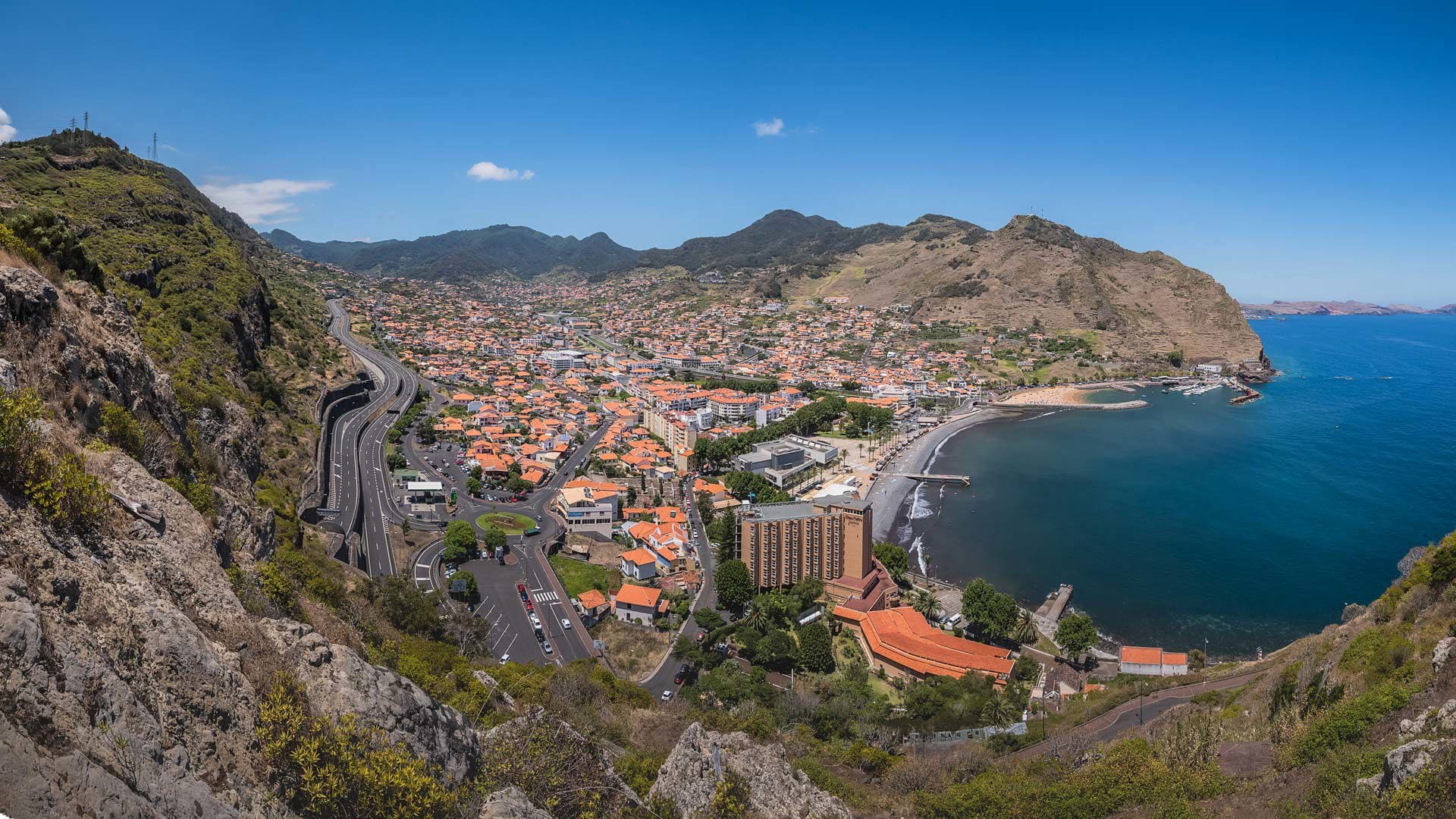
Most people who have not been to Madeira picture it as a beach destination that happens to be Portuguese — an Atlantic version of the Canaries, perhaps, or a quieter Algarve. This is wrong in almost every respect. Madeira has no significant natural sand beaches. What it has instead is something considerably rarer: nine hundred square kilometres of subtropical volcanic landscape rising from the Atlantic, threaded with ancient irrigation channels, and inhabited by a population that has been cultivating its clifftops and hillsides for five centuries. It is, by almost any measure, one of the most extraordinary islands in the world.
The misunderstanding matters because it sends the wrong travellers and disappointment follows. Madeira rewards those who come for what it is: walking through a landscape that looks like nothing else in Europe, drinking wines that are genuinely singular, staying in places that take the island seriously. It quietly disappoints those who arrive expecting a sun-and-sand package and find instead that the best the island has to offer requires a willingness to go into it rather than lie beside it.
This is an attempt to explain what Madeira actually is, where to stay inside it, and how to read the island correctly — so that the people who would love it find it, and those who would not know to look elsewhere.
What Madeira Actually Is
Madeira is a volcanic archipelago in the North Atlantic, approximately 900 kilometres southwest of Lisbon and 600 kilometres west of Morocco. The main island rises to 1,862 metres at Pico Ruivo — higher than any point in mainland Portugal — and the terrain between the coast and the peaks is a continuous series of ravines, ridges, and high plateaux that make the island geographically complex in a way that maps never quite convey.
The climate is subtropical and remarkably stable. The south coast — where Funchal sits, and where most accommodation is concentrated — is warm and sunny for most of the year, sheltered from the north winds by the central mountains. The north coast is wetter, greener, and dramatically different in character. The interior is cooler, cloudier, and in parts genuinely wild — the Laurisilva forest in the northwest, a UNESCO World Heritage site, is one of the last surviving examples of the subtropical forest that once covered southern Europe before the Ice Age.
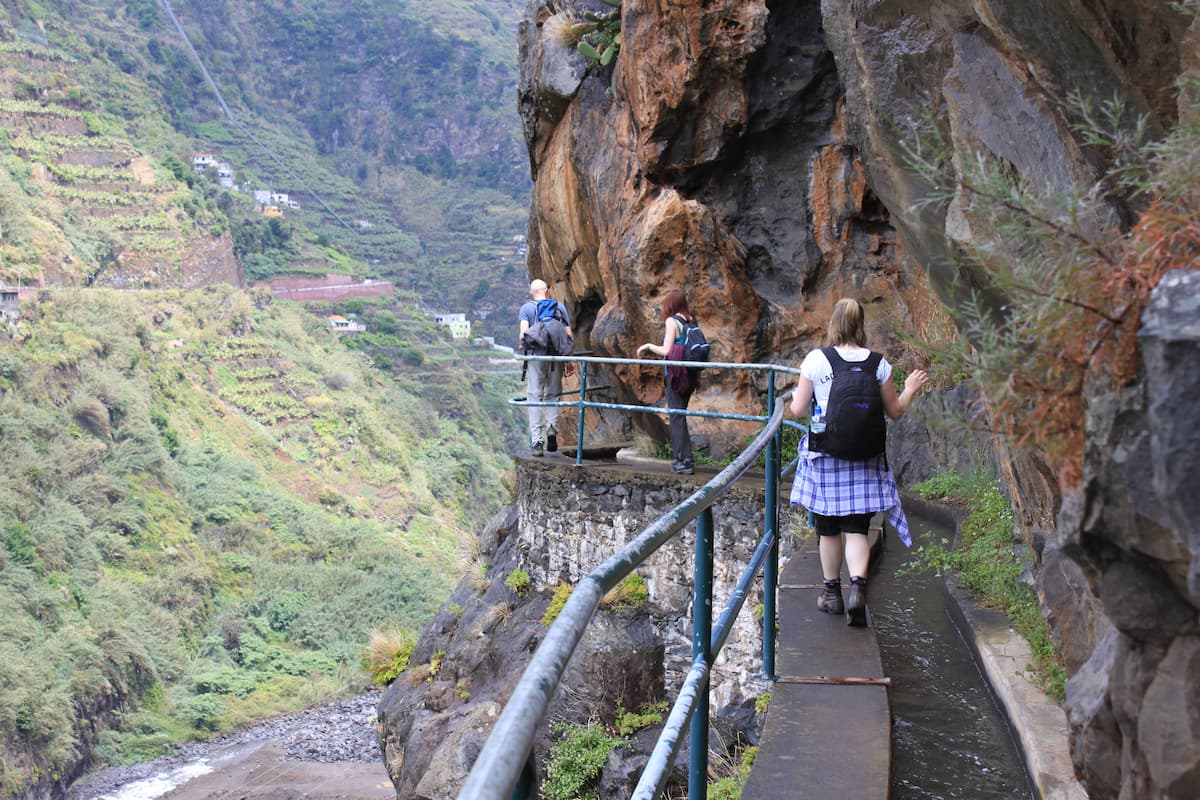
The levadas — irrigation channels built by the Portuguese from the 15th century onwards to carry water from the wet north to the dry south — are the key to the island's interior. There are more than 2,000 kilometres of levadas on Madeira, most of them with paths running alongside them. They traverse everything: clifftops, tunnels cut through rock, forested ravines, and the high plateaux above the cloud line. For walkers, they are extraordinary. For non-walkers, they remain the most practical way to reach parts of the island that road access cannot approach.
"Madeira rewards those who come for what it is. It quietly disappoints those who arrive expecting something it has never tried to be."
José Graça · PrimeStaysThe Question of Season
Madeira is genuinely a year-round destination in a way that very few places are. The south coast averages 22°C in summer and 17°C in winter — warm enough to be pleasant in any month, never hot enough to be brutal. This makes it unusual: a European island that works as well in January as in July, and where the question of when to go is shaped by preference rather than necessity.
Spring — March to May — is widely considered the best time for walkers and those who want the island at its most visually dramatic. The Festa da Flor in May transforms Funchal into an extraordinary carpet of flowers. The levadas are running well from winter rain, the Laurisilva forest is at its most vivid, and the temperatures are perfect for walking at altitude.
Summer — June to September — is the warmest and busiest period, though "busy" on Madeira is relative to the island's modest scale rather than to anywhere on the Mediterranean. The south coast is reliably sunny. The central peaks are often in cloud by afternoon, which makes early morning the best time for summit walks. The whale and dolphin watching season is at its peak — sperm whales are resident year-round, but summer brings additional species including fin whales.
Autumn and winter — October to February — are the seasons of serious value and genuine quiet. Prices drop significantly, the island empties of package tourists, and the walking conditions are if anything better — the north coast and interior are at their most dramatic in the rain, and the south coast remains perfectly pleasant. The Madeira New Year fireworks are among the most spectacular in the world, drawing visitors specifically for the display, but outside that week the island in December and January is as close to deserted as it gets.
Funchal — The Obvious Choice, For Good Reason
Funchal is where the majority of visitors stay, and this is not the failure of imagination it might appear. The city is genuinely good — hilly, layered, well-supplied with excellent restaurants, and built around a harbour that faces south into the Atlantic with the kind of confident permanence that comes from five centuries of being a serious place. The Old Town — the Zona Velha, below the cathedral — has been transformed in the last decade into one of the most interesting small urban neighbourhoods in Portugal, with painted doors, wine bars, and the kind of creative energy that tends to follow genuine architecture rather than tourist fabrication.
The accommodation in Funchal divides into two categories that suit different travellers entirely. Design hotels — properties that have taken the city's extraordinary setting seriously and built experiences around clifftop terraces, infinity pools above the harbour, and interiors that reference the island's volcanic character — are the most aspirational option and the most photographed. Quinta-style properties in the hills above the city — manor houses and estates with gardens full of exotic plants, swimming pools set among old stone walls, and views that take in the whole bay — are often better value and more distinctly Madeiran in character.
Mountain Villages — The Underused Option
The villages of the interior — Curral das Freiras, set in a volcanic crater so dramatic it was used as a hiding place from pirates in the 16th century; Santana, with its triangular thatched houses and views to the north coast; Serra de Água, quiet and cool at the island's centre — are almost entirely bypassed by international visitors, which makes them the most interesting accommodation option for those who want the island's most extraordinary landscape on their doorstep.
Staying in a mountain village means waking up on the levada network rather than driving to its starting points. It means evenings that are genuinely quiet — not performatively quiet, but the quiet of places that have no particular reason to be otherwise. And it means a version of Madeira that most visitors who have been to Funchal have never seen, even if they spent a week there.
Clifftop Villas — The Most Dramatic Option
The southern cliffs of Madeira drop directly to the Atlantic in a series of vertical faces that have no equivalent on any other Portuguese island. Private villas built on these clifftops — with infinity pools that appear to overhang the ocean, terraces facing nothing but open water, and the particular silence of places that are genuinely inaccessible from below — represent the most aspirational accommodation category on the island and one of the most dramatic in Europe.
These properties are not cheap and they require a car — the road access to clifftop locations is exclusively by the island's network of winding mountain roads. But for those who want the experience of waking up above the Atlantic with nothing between them and the horizon, there is nowhere on the Portuguese coast, mainland or island, that competes with what Madeira's southern cliffs can offer.
"A villa on Madeira's southern cliffs offers something the mainland coast cannot: the feeling of being genuinely suspended above the Atlantic, with nothing between the terrace and the open ocean."
José Graça · PrimeStaysThe Levadas, the Wine, and Everything Else
Walking the levadas is the activity that defines the serious Madeira visit. The routes range from gentle — the Levada do Caldeirão Verde in the north, threading through the Laurisilva forest — to demanding: the traverse from Pico do Arieiro to Pico Ruivo, at over 1,800 metres, with views in clear conditions across to the island of Porto Santo and the Desertas. What the levadas share is the quality of the landscape they pass through — a consistent visual richness that comes from walking through a genuinely ancient and undisturbed ecosystem.
Madeira wine deserves more attention than it typically receives from visitors who associate it with cooking or grandmother's cooking sherry. It is in fact one of the most distinctive and age-worthy wines in the world — the only wine that improves from heat and oxidation, due to a fortification and ageing process developed in the 18th century when Madeiran wine was used as ballast on Atlantic trading ships and discovered to improve dramatically during the crossing. The wine lodges of Funchal — Blandy's, Henriques & Henriques, Barbeito — offer serious tastings of wines going back decades. A Madeira Sercial aged twenty years is unlike anything else in a wine cellar.
Whale and dolphin watching is the island's most underrated experience. Madeira sits on a deep-water channel that is one of the richest cetacean habitats in the Atlantic — sperm whales are present year-round, and seasonal visitors include fin whales, blue whales, and multiple dolphin species. The boats operate from Funchal harbour and use traditional Madeiran lookouts positioned on the clifftops to spot animals before the boats approach. It is a genuinely different experience from the whale watching operations on the mainland coast.
Madeira vs the Mainland — Who Should Go Where
Madeira is not interchangeable with any part of mainland Portugal. The traveller who comes to Madeira for quiet luxury is looking for something different from what Comporta offers, even if both destinations share the word "quiet." Comporta is flat, oceanic, pine-forested, and built on an aesthetic of deliberate simplicity. Madeira is vertical, subtropical, geologically dramatic, and built on five centuries of cultivation that have layered the island with terraces, quintas, and a wine culture that has no equivalent anywhere.
The traveller who would be most satisfied in Madeira is the one who wants natural complexity — a landscape that rewards engagement rather than passive contemplation. They are interested in wine, in walking, in staying somewhere that is genuinely different rather than differently beautiful. They appreciate that the island's lack of beaches is not a deficiency but a definition: Madeira is what it is precisely because it is not what other places are.
For a broader comparison of where to stay across Portugal, the region by region guide covers all the major destinations and how to choose between them.
every fortnight.
Editorial picks, honest notes, new destinations before they go mainstream. Free, always.
Join the list