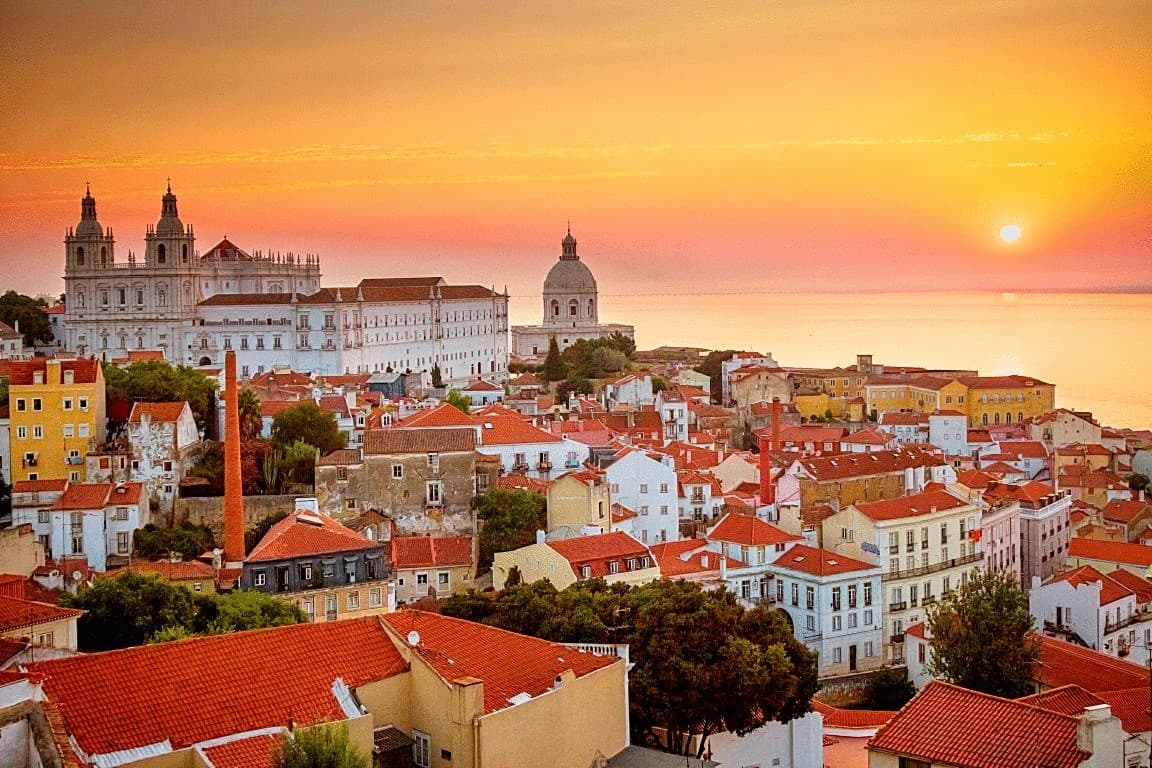
Lisbon is a city that rewards the visitor who approaches it correctly and gently disappoints the one who does not. The correct approach is this: three or four days in the city itself, concentrated in two or three neighbourhoods rather than distributed across all of them, followed by a day in Sintra and possibly another at Arrábida or Cascais. The visitor who tries to see all of Lisbon in a week will spend most of it walking uphill and wondering why the next neighbourhood is so similar to the last. Lisbon is not a wide city — it is a deep one.
The city is built on seven hills above the Tagus estuary, and its geography — steep, tram-threaded, and covered in the hand-painted ceramic tiles that give the city its singular visual character — means that neighbourhood choice shapes everything. The right neighbourhood means that your hotel or apartment is a base for the things you want to do rather than a starting point for long walks to reach them. The wrong one means that every outing begins with a tram queue or a taxi.
This is an honest guide to Lisbon's main districts — who each suits, what each offers, and how to use the city efficiently without feeling that you are being efficient.
Alfama & Mouraria — Historic, Atmospheric, Steep
Alfama is the oldest surviving neighbourhood in Lisbon, draped across the hill below the Castelo de São Jorge in a tangle of streets that predates the 1755 earthquake — the catastrophe that destroyed most of the city — because it sits on bedrock rather than the marshy ground that collapsed elsewhere. It is the neighbourhood most associated with fado, with the city's Moorish past, and with the particular quality of Lisbon that photographs best: narrow streets, washing lines, tiled façades, and views over the rooftops to the Tagus.
It is also genuinely difficult to live in if you have luggage, bad knees, or any intention of driving anywhere. The streets are too narrow for most cars, the gradient is severe, and the tram that serves the neighbourhood — the famous Number 28 — is so overcrowded in tourist season that it is effectively unusable as transport. Staying in Alfama is a statement about what you want from Lisbon: the most atmospheric, the most photographed, and the most physically demanding version of the city. For first-time visitors who are young, fit, and willing to be enchanted at the cost of convenience, it is the right choice.
The oldest and most photographed neighbourhood — azulejo facades, fado houses, the castle above. Genuinely beautiful and genuinely inconvenient. Best for those who prioritise atmosphere over logistics and do not mind steep streets. Mouraria, just below, is slightly more local and slightly less steep.
Chiado & Bairro Alto — Cultured, Central, Well-Served
Chiado is Lisbon's most elegant neighbourhood and its most consistently pleasant base for a city visit. It occupies the high ground between the Baixa — the flat commercial district rebuilt after the earthquake in a grid of Pombaline architecture — and the Bairro Alto, and it has the quality of a neighbourhood that has been taken seriously for a long time: good bookshops, good coffee, good restaurants at multiple price points, and the best concentration of independent shops in the city. The Livraria Bertrand — the oldest operating bookshop in the world, established in 1732 — is here, as is the Museu do Chiado and a concentration of art galleries that makes the neighbourhood the cultural centre of the city.
The Bairro Alto directly above Chiado is the city's traditional nightlife district — narrow streets packed with bars that open at 10pm and close at 4am. For visitors who want the daytime quality of Chiado with the option of a late evening in the Bairro, staying on the boundary between the two is the most flexible choice. For those who want early nights and no noise, a hotel in Chiado proper rather than on the Bairro Alto side of the neighbourhood is important to specify.
The most elegant base in Lisbon. Chiado has the best independent culture in the city — bookshops, galleries, good restaurants. Bairro Alto for late nights. The neighbourhood is hilly but not as steep as Alfama. Central enough to walk to most of what matters.
Príncipe Real & Santos — Design, Calm, Residential
Príncipe Real is the neighbourhood that Lisbon's design-conscious residents and returning visitors choose when they know the city well enough to move past Alfama and Chiado. It sits on the ridge above Chiado, slightly west, and has a character that is residential and calm while still being walkable to everything — a weekly antiques market in the main square, the city's best wine bars concentrated along a single street, and the kind of independent shops that have survived by being genuinely good rather than generically appealing.
Santos, just below Príncipe Real on the way to the river, has been the subject of significant investment in the last five years and now has some of the most interesting new restaurant openings in the city. It is quieter than Chiado, more local in atmosphere, and increasingly interesting as an alternative to the more obvious choices. For those on a second or third visit to Lisbon who want a base that feels genuinely residential rather than touristic, Príncipe Real and Santos are the neighbourhoods to consider.
The neighbourhood that Lisbon's residents recommend when asked where to stay. Quieter than Chiado but walkable to everything. The best wine bars in the city. Santos for new restaurants and a more local atmosphere. The right choice for a second visit.
Belém & Ajuda — Historic, Spacious, Out of the Centre
Belém is where Lisbon makes its grandest gestures. The Torre de Belém, the Mosteiro dos Jerónimos, the Monument to the Discoveries — all of them concentrated along the riverfront west of the centre, in a neighbourhood that was once the departure point for Portugal's great maritime expeditions. It is also where the original Pastéis de Belém are made — the custard tarts that have been produced at the same address since 1837 and that remain, despite the city's conversion to a pastry tourism economy, genuinely worth queuing for.
Staying in Belém is a specific choice that makes sense for those who want the monuments but are willing to trade central convenience for more space, a riverside location, and significantly lower prices than Chiado or Alfama. The number 15E tram connects Belém to the centre in about 20 minutes, and the riverside cycling path is excellent. It is not the right choice for a short first visit — too much time will be spent in transit — but for longer stays it offers a different, more residential Lisbon.
Grand riverside neighbourhood with Portugal's most significant monuments. More space, lower prices, and a calmer atmosphere than the central areas. Best for those who want a different pace — connected by tram and riverside cycling path to the centre.
"Lisbon is not a wide city. It is a deep one — and three days done well is worth more than seven done anxiously."
José Graça · PrimeStaysSintra, Cascais & Arrábida — The Essential Escapes
The most important thing to understand about Lisbon as a destination is that its greatest assets are not all inside it. Within an hour of the city centre are three places that, individually, would justify a trip to Portugal independently of Lisbon itself.
Sintra — 40 minutes by train from Rossio station — is one of the most extraordinary places in Portugal. A UNESCO World Heritage site of forested hills, Romantic-era palaces, and a permanent population that has never quite decided whether it prefers to be a village or a cultural institution, Sintra is the day trip from Lisbon that most visitors feel they could have spent an entire week in. The Palácio da Pena, the Quinta da Regaleira, the Convento dos Capuchos — each individually worth the journey. Arriving before 10am or after 4pm makes a significant difference to the experience in summer.
Cascais — 40 minutes by train along the Tagus estuary — is the most pleasant coastal base within range of Lisbon. An aristocratic resort town that has maintained its character despite becoming a comfortable commuter destination, Cascais has good restaurants, a proper waterfront, and beaches that serve as the Lisbon coast's most accessible option. For visitors who want to spend part of their time at the ocean without committing to the Algarve, Cascais makes an excellent base for two or three nights of a longer visit.
The Arrábida Peninsula — an hour south of Lisbon by car, not accessible by public transport — is the natural landscape within range of the city that most consistently produces the reaction "I had no idea this existed so close to a capital." A limestone mountain range dropping directly to turquoise water of unusual clarity, with beaches accessible only by boat or by steep footpaths, and a marine park that protects some of the clearest seawater in Portugal. A half-day trip in combination with lunch at a restaurant in Setúbal is one of the best days possible within the Lisbon region.
The Honest Framework — Days, Not Itineraries
The visitors who leave Lisbon most satisfied are almost always those who resist the temptation to cover everything and instead choose two or three neighbourhoods, two or three restaurants, and one or two day trips — and do those things properly. Lisbon is a city that rewards the unhurried walk more than the scheduled visit. The best moments are almost always the ones that were not planned: the miradouro discovered by following a street uphill, the tasca found because the intended restaurant was full, the conversation with a tram driver who speaks better English than you expected.
A practical structure: two days in the city itself — one anchored in Alfama and the castle, one in Chiado and Príncipe Real — plus one day in Sintra, and one day for Cascais or Arrábida depending on whether the ocean or the landscape is the priority. Four days, done this way, gives a version of Lisbon that most seven-day visitors never quite achieve.
every fortnight.
Editorial picks, honest notes, new destinations before they go mainstream. Free, always.
Join the list